Hospitality — Albanian Style
by christopher thornton
An Albanian’s house is the dwelling of God and the guest ... So before it is the house of its master, it is the house of one’s guest. The guest, in an Albanian’s life, represents the supreme ethical category, more important than blood relations. One may pardon the man who spills the blood of one’s father or of one’s son, but never the blood of a guest.
—Ismail Kadare
It is not hard to find one’s way around the center of Tirana, Albania. The major streets radiate from central and spacious Skanderbeg Square in the familiar grid, common in most cities of the world. But in Tirana, as in most cities, there are exceptions—smaller lanes that complicate the greater grid, and diagonal avenues that angle in a mishmash of directions. The brewpub I was looking for was tucked away somewhere down one of them.
The map I was using had its limitations, so I stopped at a café to ask for directions. I was greeted by the owner, and at the moment the manager, host, bartender, and only table server. She took a moment to give me directions as clearly as she could, but precision was lacking.
“Just go around to the left and down the street behind us. You’ll see it on the left.”
As simple as it sounded, “down” and “behind” can become very vague when applied to any city, especially an unfamiliar one, so I watched her hand gestures for a better sense of where to go. She noticed and stopped.
“Come,” she waved, “follow me.”
She led me through the bar and into the kitchen and out a back door that opened onto a parking lot that joined the street “behind us.” From there she pointed into the deepening dusk.
“See it?”
I didn’t, and from where we were standing no one could.
“Come,” she said.
She led me across the lot, and the neon sign of the pub now appeared above a cluster of parked cars.
“Now, see?”
I did. The lights glowed brightly, even garishly, and were the only lights on the darkening street.
I thanked her, and thanked her again, and she simply smiled and returned to her untended tables.
Here I must backtrack, for reasons that will become clear.
On my first trip to Albania I was looking for a square that served as the bus station from where regional busses were dispatched to all parts of the country. It was the way that almost all Albanians travel, intra-country—lugging shopping bags from the chain stores in the capital back to their villages and towns in the more distant reaches—by packing into broken-down 12-seat minibuses that provide the transport links that knit the small and disconnected regions together. The one I was looking for covered a route that stopped at the Castle of Kruja, or the Skanderbeg Citadel, a 15th-century castle about 25 miles from the city and named for Albania’s national hero, who fought against all regional powers who threatened the country’s national sovereignty.
From the center of the city I took a local bus to the northern end of Tirana, where I was told the bus station could be found, but after a bit of searching it was not to be. A group of commuters was gathered at the bus stop across the street, so I asked one of the men about the bus to the Castle of Kruja, or the Skanderbeg Citadel. Quandary filled his face, but only for a moment, and then:
“Follow me.”
I did. He led me through a passageway that separated two office buildings, around the rim of a traffic roundabout and a short walk up one of the roads that angled to the right. Further ahead a cluster of minibuses was waiting for passengers, their side doors open, their drivers calling out destinations to fill the remaining seats so they could start on the road. He wandered between the buses, asking the drivers for the bus to Kruja.
“Here!” he called out. He found the bus that would stop at Kruja—not the castle but the town, and from there I could walk to the castle. But there was more: “The driver will tell you when to get off.” About an hour later he did.
I thanked the mysterious helper for his trouble and was about to add a few more words of appreciation, but he was already on his way back to the bus stop to catch another bus that would never catch up to the one he had long missed.
Even before my first trip to Albania I’d learned a little about the country to know what to expect. I’d heard that when an Albanian is asked for directions they won’t just describe the way but take you there. This could happen in any other country, but this was Tirana, and this was Albania, and Albania is not any other country. In Albania the guidelines for human behavior in dealing with one’s neighbor, or “outsiders,” have been governed by the principle, and obligation, of besa.
Like so many traditions in so many parts of the world, what we experience is the sweet aroma of the flower, while the roots have been deeply anchored into the native soil. Besa is one of them. Also like many cultural notions, besa has no neat translation. Call it a “solemn oath,” ”word of honor,” or “sacred pledge,” and we creep a little closer to its meaning. It goes further. Someone who is faithful, trustworthy, or reliable is said to be besnik. Besnik is also a common name for Albanian men.
Any explanation of the concept besa soon arrives at a fork in the road. One leads to the Statutes of Suctari, named for the Albanian town of the same name—now Shkoder in today’s Albania. The Statutes, written in the 15th-century language of the Venetians, refer to the verb bessare—“to make an oath.” But some further backtracking is needed.
The other direction points eastward. In the late 19th century the Ottoman government, produced an almanac titled Kosova Salnamesi that attempted to define besa over two pages, but in the end could only draw a parallel to the French parole d’honneur, or “word of honor.”
Simple sayings may explain besa better, whether they come from Albanians or conquerors/occupiers: “An Albanian who says besa once cannot in any way break his promise,” so said the 19th-century Ottoman grand vizier Mehret Ferid Pasha, in 1903.
The grand vizier may have been a little overwhelmed by the challenge and opted for an easy explanation, accessible to the contemporary mind. Had he gone down the other path he would have arrived at the Kanun, the Albanian tribal code of laws that, some claim, originated in the 15th century and was passed along through oral tradition until it was finally transcribed in the 19th century.
Then there is the amanet, characterized as a will or pledge by Albanian tribes, which predates the arrival of both Christianity and Islam. Here we find a connection to a passage from the Bible: “In the beginning was the word,” which was interpreted by early Albanian converts to Christianity as “to make a promise” or “to offer one’s word”—and so we come full circle.
No matter how definitive this may seem, in describing besa it only goes so far. To go further we must dig into the Kanun, the set of customary laws that governed Albanian tribal society in pagan times, and would later appear in the codes of conduct shared by all religious sects, Christian, Muslim, and Jewish.
“What is promised must be done,” states the Kanun.
But we must still dig deeper.
The origin of kanun dates to ancient Greece and the word “canon,” or set of laws. Like so many concepts in the eastern Mediterranean, this term hopped from Greek into Arabic, and then into Turkish before arriving in Albania, where it acquired the significance of halal in Arabic or kosher in Hebrew, where kanun meant permitted or allowed.
And now we creep closer to home. Within the Kanun we find the principle of besa interwoven with the code of conduct in the treatment of guests: “The master of the house should at have a spare bed available at any time of the day or night in case a guest arrives unexpectedly.” Another article (601) states: “The house of an Albanian belongs to God and the guest.” And article 603: “The guest must be honored with bread and salt and heart.” Article 604: “Receive a guest with a fire, a log of wood, and a bed.”
To see the influence of the Kanun, and therefore the concept of besa on modern history, we can look to World War II. Before the war the Jewish population in Albania numbered only about 200. By the end of the war it topped 2,000—Albania being the only European country to see an increase in its number of Jews by the end of the war. The reason is simple: many Jews in neighboring countries heard that Albanians were taking in refugees, so many fled to the Muslim majority country. In 1943, with the Nazi regime encircling the Balkans, Prime Minister Mehdi Frasheri stated: “All Jewish children will sleep with your children, all will eat the same food, all will live as one family.”
Those who sought a safe haven in Albania included Italians fleeing Mussolini’s fascism and soldiers defecting from the Nazi ranks. A few decades later, during the breakup of the former Yugoslavia, half a million Kosovars found refuge in Albania from the Serbian military. Most were ethnic Albanians, but not all.
But back to today’s Albania. A recent trip took me to the southern city of Girokaster, a little more than a stone’s throw from the Greek border. The Old Center is a UNESCO World Heritage site, owing to the many Ottoman-era houses that sprinkle the cobbled streets. Girokaster is the birthplace of Ismail Kadare, winner of the Nobel Prize for Literature—but also Enver Hoxha, the hardline dictator who ruled the country until 1989 and the end of communist rule. The hotel where I was staying was in the New Town, the swath of development that spreads from the base of the mountain on which the Old Center was built.
The manager, desk clerk, and all-around host was Arben, and for the first few days I watched him prance up and down the four floors to meet the needs of the more and less demanding guests. Whatever it was—a ride to the airport or advice for the best restaurants in the Old Town—Arben was taxed for an answer. After a few days I was added to the list: I had forgotten the charger for my camera battery and had to restore its power before it went completely dead. I stopped at one camera shop but it didn’t have the appropriate charger to fulfill the task. Back at the hotel I asked Arben —Did he know of another?
A moment of pondering, and then:
“I think so—follow me.”
I did. He led me up the slowly rising shopping street that led to the base of the mountain. After a few blocks we arrived at a photo shop. He explained the problem to the owner and her daughter, who made up the staff. Yes, they could charge the battery, but it was near closing time so I’d have to leave it overnight. I agreed, and they asked me to add my initials to the case to separate it from the many others they had lying around.
The next morning I returned to pick it up. It was fully charged, the daughter told me, enough to last two days, and if it didn’t I could bring it back and they would try again. I asked about the cost: none.
The camera was fine and functional for the rest of the day, and the next, but a new snag appeared. Near the end of my last day I slipped on a trail inside the 12th-century fortress and crowns the ridge overlooking the city. I’d tripped and fell against a rock that tore my jeans a little below the knee. A tragedy it wasn’t, but it meant a part of my pants’ leg was flapping freely, and it was the only pair I’d brought with me.
Back at the hotel I again sought out Arben and asked where I might find a needle and thread. It was almost the end of the day. Would any shop still be open? This time there was no pause, just: “Follow me.”
I did. He led me around the back of the hotel and through a parking lot where there were no needles nor thread for sale but a seamstress shop. It was closing time, but Arben had a few words with the owner. I slipped off my pants and waited in a dressing room while she went to work, the sewing machine whirring and spinning as the torn denim was stitched back into place. In a few minutes the job was done. I paid for her handiwork, and for the besa granted.
“The besa of an Albanian is not for sale,” so goes a popular saying, and this was a case in point—I paid for the stitching, not for staying open beyond closing time.
She returned to closing up and Arben and I left, but Arben’s mission wasn’t over.
“Let’s have a raki,” he said.
Raki is the tipple of choice in Albania and the rest of the Balkans—a mixture of grape and aniseed that produces a water-clear liqueur that is customarily sipped in small glasses. There was no need to ask where, because Arben knew the perfect place for the perfect raki. For a few days he had been goading me to share a raki, and for a few days I had been politely evasive, not because I was shunning the invitation but because it came at odd times when I was either arriving at or leaving my room. But now there was no escape, and I wouldn’t have wanted one.
We settled in at a table on a terrace near the seamstress’s shop, where almost all of the customers are locals who know where to come for the best raki, because— Arben made clear—here it was homemade, with no additives that, he said, “pollute” the modern brands, and there was no reason to believe it wasn’t true.
The owner brought us two glasses. We clinked and sipped. The raki was clear and smooth, sip after crystalline sip, undoubtedly strong, but in the pure and silky way that is the sign of the best quality raki.
Our glasses empty, I said I had to use the toilet, but it was a ruse. I really went to pay, but it was too late. As soon as we had sat down it was too late. Arben was a klient i rregullt—a regular, or habitue—in Albania, so anything he ordered, for himself or his guest, was added to his account.
I felt a twinge of guilt for putting him off the last few days, but pleased that I could finally fulfill the role of an appreciative and gracious guest—Albanian style. Had the last hour not passed the way it did, would Arben have abandoned his effort at raki sharing? Some popular sayings provide an answer:
The besa of an Albanian is worth more than gold,” goes one.
“An Albanian would die before he violates besa,” says another.
———————————————————
———————————————————
Christopher Thornton in the Department of American Studies at Jagiellonian University in Krakow, Poland. He was written dozens of essays on travel-related topics, including two books on Iran. The first was titled Descendants of Cyrus: Travels Through Everyday Iran, published by the University of Nebraska Press.
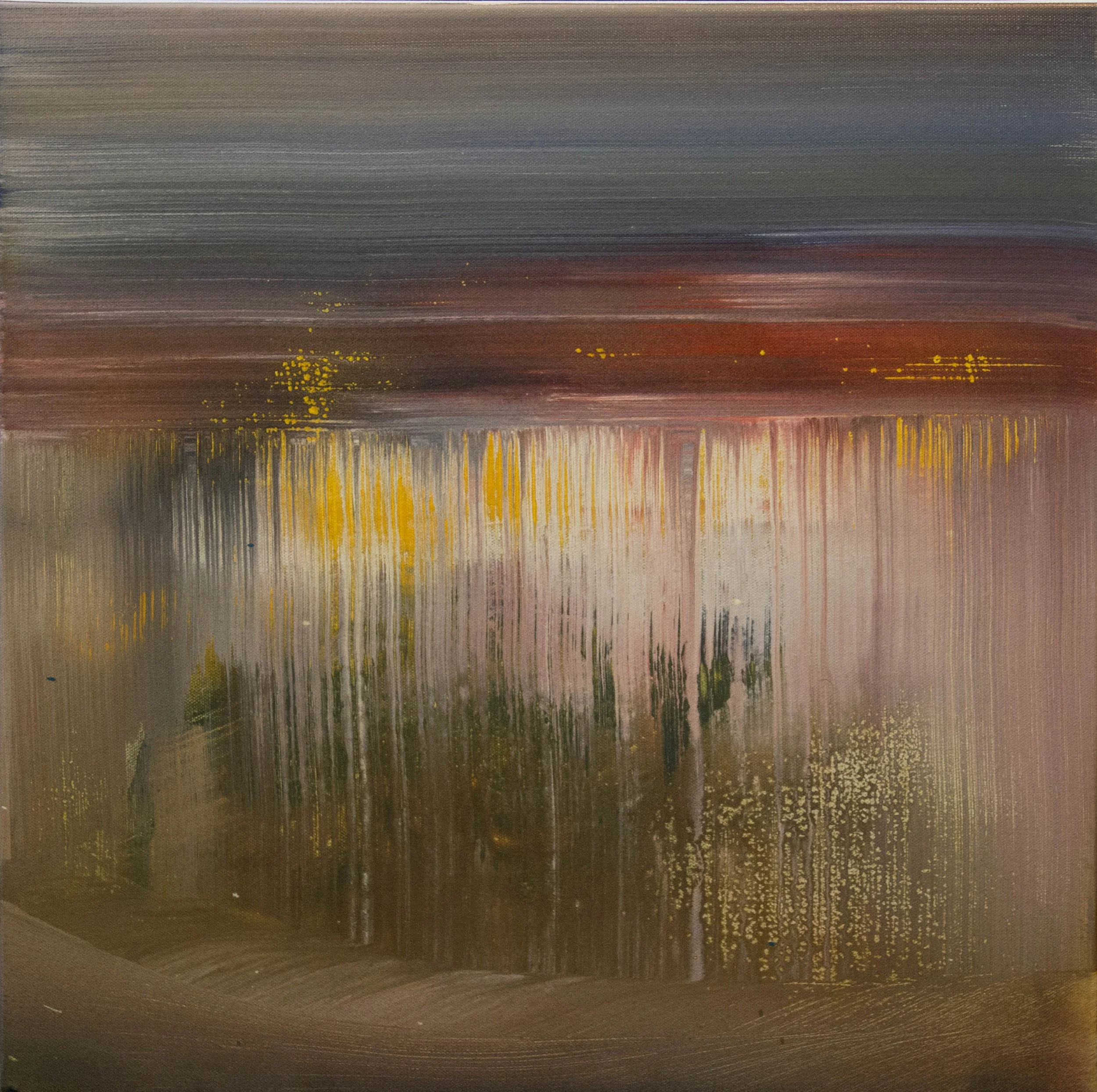
ART:
Ramsay Wise
#31 Sunset
Spray paint and acrylic
20x20