STIRRING
Founded in 1999, Stirring is one of the oldest continuously publishing journals on the internet.
Stirring is an electronic quarterly journal.

Founded in 1999, Stirring is one of the oldest continuously publishing journals on the internet.
Stirring is an electronic quarterly journal.
KAWTAR LOURHRAZ
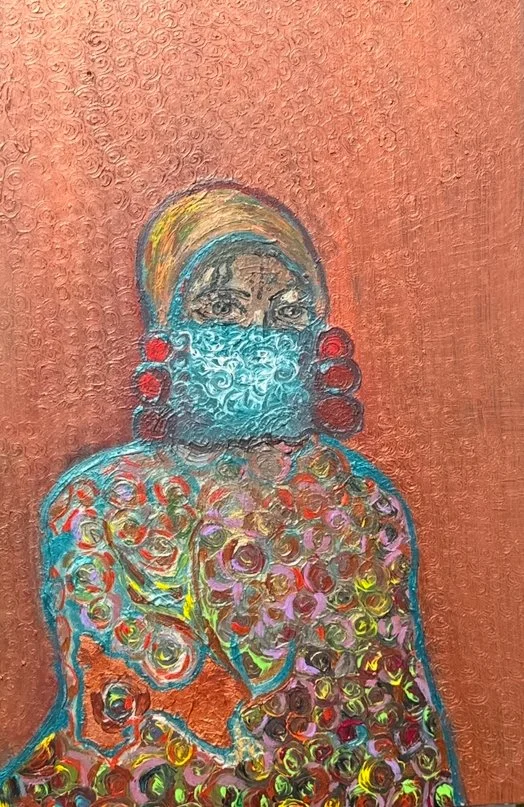
Art provided by the author
The first portrait I ever painted from memory belonged to someone whose face I had never seen. Not memory in the ordinary sense. I have no recollection of her voice drifting through a Riad, no memory of her hands braiding my hair. My grandmother died before I was born. Everything I know about her has been inherited the way some families inherit jewelry or land. I inherited stories. Her name was Hada Bent Brahim that means, “Hada, the daughter of Brahim” in Moroccan Darija. My father carried her stories for decades before he began handing them to me, one at a time, usually without realizing it. They emerged in quiet conversations during long drives, over hot mint tea, in the pauses between ordinary life. He never sat me down and said, "Let me tell you about my mother." Instead, stories about her appeared the way memory often does, in fragments. Her story starts on a warm afternoon. She was twelve years old and had not yet begun menstruating. That afternoon she was sitting outside, carving little wooden dolls and dressing them in Caftans. Then her aunt called her to come inside the house and to stop playing. She told my father she was taken from the street before she understood what was happening, the women gathered around her and someone sat her down, then held out her hands. Fresh henna was spread across her palms in delicate patterns that meant nothing to her child like world. She had told my father that the only memory she has of that night is the fresh smell of the Moroccan Henna.
I have always found it to be remarkable that memory is sometimes carried not by words or images but by scent. Long after names fade and faces blur, the senses remember. They dressed her as a bride and led her away. As she left, women filled the air with ululations (Zagherouta), a sound meant for joy. I have heard those sounds at celebrations throughout my life. They echo through streets, bounce against old stone walls, rise into the evening sky. They belong to weddings, births, reunions and are sounds of happiness. My grandmother heard them differently. What she heard was her childhood left behind that night, I do not picture a bride when imagining that day. I picture a little girl wondering what would happen to the dolls she never picked up again.
For years I thought this story belonged only to my family. As I grew older, I realized it belonged to countless women born in my grandmother's generation. Women whose childhoods ended before they had the language to describe what they were losing. I was shocked to know that those women still exist in our generation and child marriage is still common in many countries. Hada was born in 1940 into the Ait Zekeri tribe in southeastern Morocco, where Amazigh traditions had been carried across generations through memory rather than books. Women were the keepers of songs, recipes, weaving patterns, rituals, and stories. They preserved entire worlds without writing them down. Her mother tongue was Amazigh, a language older than Latin and as ancient in spirit as the Ancient Egyptian language. A language that is still spoken, sung and alive in the voices of its people.
My grandmother could not read and never went to school. History might call that illiteracy, but my father calls it injustice. My father often reminded me growing up how fortunate I was compared to the women who came before me. Yet even as a child I noticed something strange whenever he spoke about her. He never described her with pity, he spoke about her with admiration, and he remembered her laughter before her hardships. He remembered her generosity before her suffering and her insistence that every one of her children receive the education she never had. That insistence shaped my father's life as well as mine. Whenever I think about education, I think first of my grandmother because she never received it.
There is a quiet kind of wisdom that comes from recognizing what you never had. My grandmother possessed that wisdom and spent her life ensuring her children inherited the opportunities that were never presented to her. As I listened to these stories growing up, I never imagined they would one day become a painting. I thought they would remain family history, carried from my father to me and perhaps someday to my own children. I did not yet understand that memory, if left untended, can disappear. I would learn that lesson standing before a grave whose name had almost vanished. My grandmother lived most of her life after that day as a wife and mother.
The child who had once sat in the dust carving wooden dolls grew into a woman whose life was defined by the rhythm of survival. She gave birth to twelve children and raised them alone in a world where nothing about motherhood was soft or symbolic. It was labor and repetition. It was endurance stretched across years that rarely offered rest. She never learned to read and never wrote her name. If her life had been recorded on paper, there would be no chapters, no punctuation marking turning points, no narrative arc leading toward resolution. Only days that followed one another until they stopped. And yet, within my family, she was not a footnote. She was the center.
My father often returned to the same image when speaking about her. He was a boy, reluctant to study, sitting with a book in his hands while his mother insisted he continue. Only later did he realize that she had handed him that book upside down. She could not read a single word. And still believed education could transform his life. I have always thought about what it means to believe in something you have never experienced for yourself. Hada believed in education the same way that some people believe in prayer. Not because she understood its mechanics, but because she understood its power.
In 1980, while traveling to a wedding, she died suddenly in a car accident. She was forty years old at the time and left behind her grieving children. After her death, my grandfather eventually remarried a younger woman within a month after the tragedy. My father recalls conversations he had overheard during his mother’s funeral where people were proposing younger and more beautiful woman for his father to marry. Life reorganized itself the way life always does. Children grew, houses filled again with order, new conversations replaced old ones and slowly, without anyone deciding it would happen, Hada began to recede. Not from memory entirely but from presence.
She became someone spoken about rather than someone lived with. Her absence was no longer urgent, she became nostalgia. That is how forgetting begins not with erasure, but with continuation. Years later, I traveled to her grave for the first time. It was located in the region of Marrakech, in a small burial ground that did not announce itself. There was no ceremony in the arrival, no sense that I was entering a place of importance. Only earth, wind, and scattered vegetation growing where time had been left unchecked. I was still a child and remembered expecting something different. I do not know exactly what I expected, something like preservation or care for a life so central to my family that had been honored by the ground that held it. Instead, I found neglect.
Plants had overtaken the stone. Weeds grew over the edges of the grave as if the earth itself had begun to forget her name. I knelt down, trying to read what remained of the inscription, but the letters had been worn away until language itself had collapsed into surface and shadow. Her name was nearly gone, Hada Bent Brahim. I remember feeling something I did not yet have the words to name. It was not only sadness but also disbelief. How could a woman who had carried twelve lives into the world, who had endured a childhood taken from her, who had shaped the future of an entire branch of a family, be reduced to something so fragile that even her name could disappear?
I stood there for a long time, no one spoke, and the wind moved through the plants that had claimed her resting place. Then I understood without anyone telling me, that memory is not guaranteed. It must be maintained otherwise it dissolves quietly and without protest. That image stayed with me long after we left. A grave overtaken by life, a name erased by time, a woman who had once been at the center of a family now returning to silence. Years later, when I began painting, I did not immediately understand why I kept returning to her. At first, I thought I was painting a portrait, but what I was actually doing was something else. I was trying to recover what had been allowed to disappear. I was trying to give shape to a life that had no photographs, no written archive, no preserved voice. I was trying to rebuild a presence from fragments my father’s memories, my imagination, and the emotional residue of stories I had heard too many times to forget.
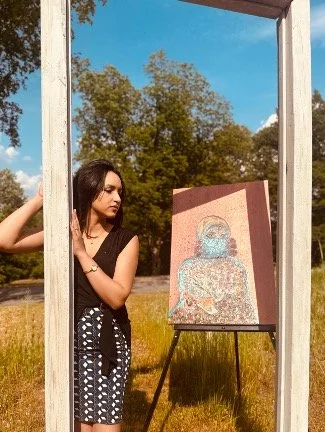
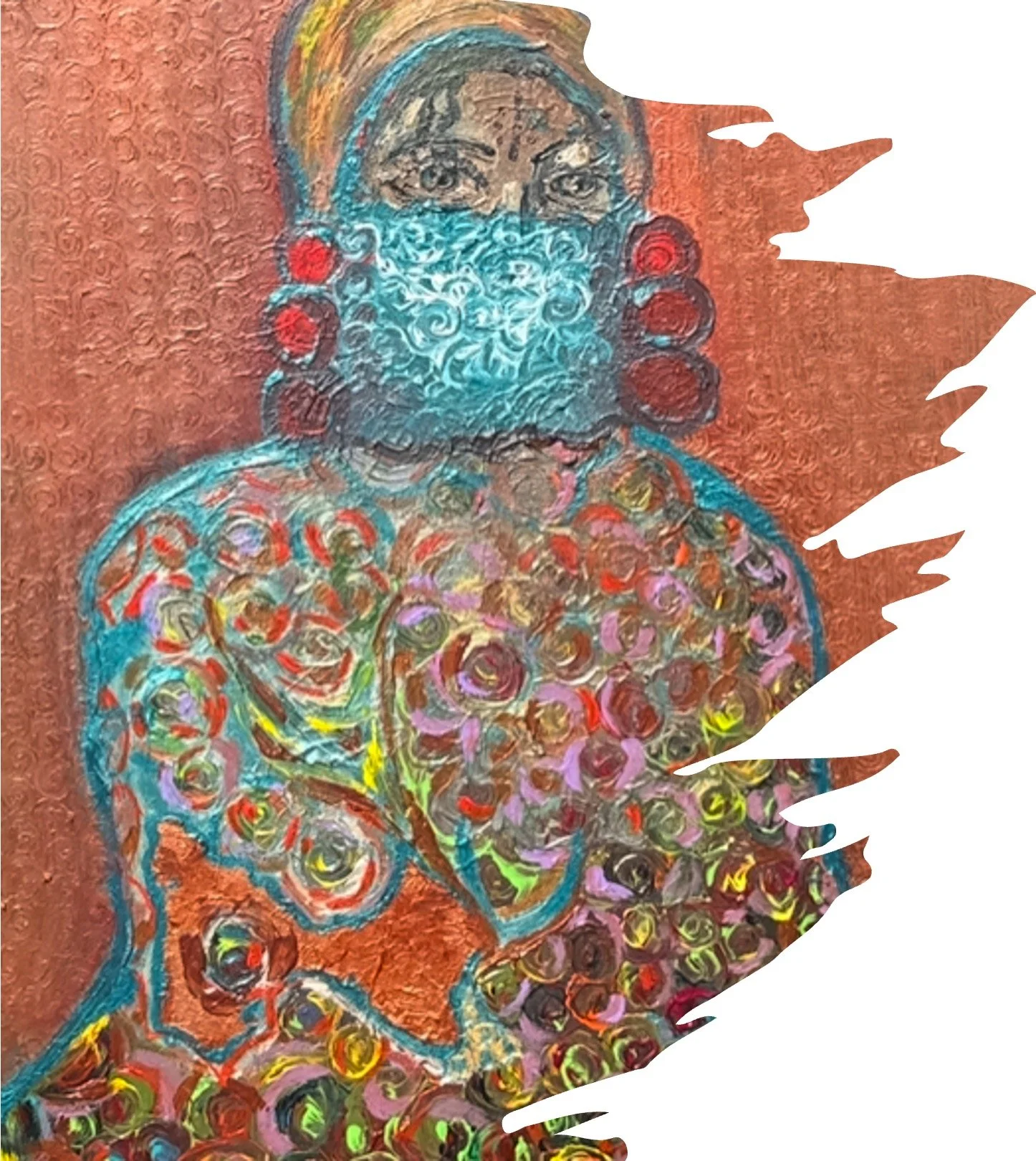
In the studio, Hada did not arrive all at once. She appeared slowly as if she was testing whether she could still be seen. I painted her not as she was remembered, but as she was felt. A woman shaped by loss and endurance, A woman who had once held wooden dolls before being taken into a life she did not choose. A woman whose hands had once been covered in henna whose scent she would remember for the rest of her life. Each brushstroke felt like an attempt to return something to its place. Not to restore the past but to refuse its disappearance. For a long time, I believed my life had moved in a completely different direction from my grandmother’s. I became an engineer and my world was built on structure, systems that could be measured, solved, and optimized. There was comfort in that clarity. In engineering, problems are expected to have solutions. Variables can be controlled. Outcomes can be predicted if enough information is known. But there were questions in me that did not behave like equations.
No matter how precise my work became, there remained something unmeasurable that followed me everywhere I went. The feeling that certain lives had been lived without ever being recorded and that I was carrying the weight of stories that had no formal place in the world I was building for myself. Hada’s story lived in that space, not as information but as absence. The more I worked in structured environments, the more I found myself returning to her. Not consciously at first, it happened quietly. A moment of stillness between tasks, a sentence from my father, a memory resurfacing without warning: wooden dolls, henna, a grave overtaken by plants.
I did not decide to become an artist in a single moment. It happened gradually, like something insisting on existing. When I began painting, I told myself I was simply exploring another form of expression, but I quickly realized that what I was doing was not exploration. It was return. I returned to Hada without knowing how to paint her. There were no clear photographs to guide me. No recorded expressions. No archival image of a woman at twelve, or twenty, or forty. Everything had to be reconstructed from fragments that did not align in any logical way.
My father’s memory became my only reference, but memory is not stable material. It shifts depending on who tells the story, when it is told, and what is being felt at the time of telling. So, I painted from something even less stable than memory. I painted from inheritance. From the emotional residue of stories passed down so many times that they had become part of my internal landscape. In the studio, Hada did not take shape immediately. At first, the canvas resisted her. I would begin and stop. Start again. Erase. Rebuild. It felt less like creating an image and more like trying to listen for something that was not speaking directly. Eventually, I stopped trying to “see” her clearly. Instead, I began to feel her presence through symbols that had survived in the stories: the wooden dolls she once made as a child, the scent of henna that stayed with her for decades, the silence that followed her departure from her childhood home, the weight of motherhood carried across twelve children.
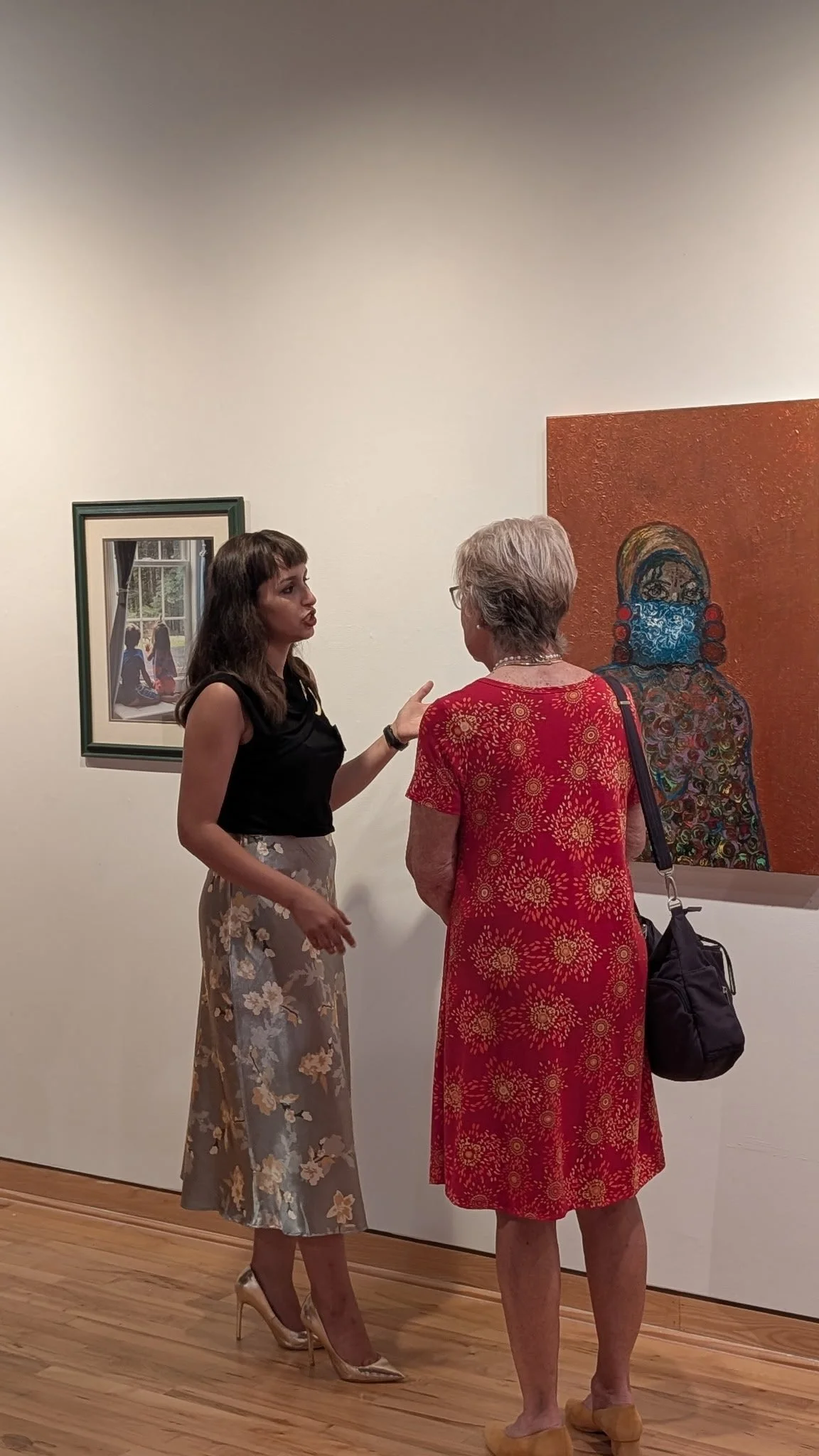
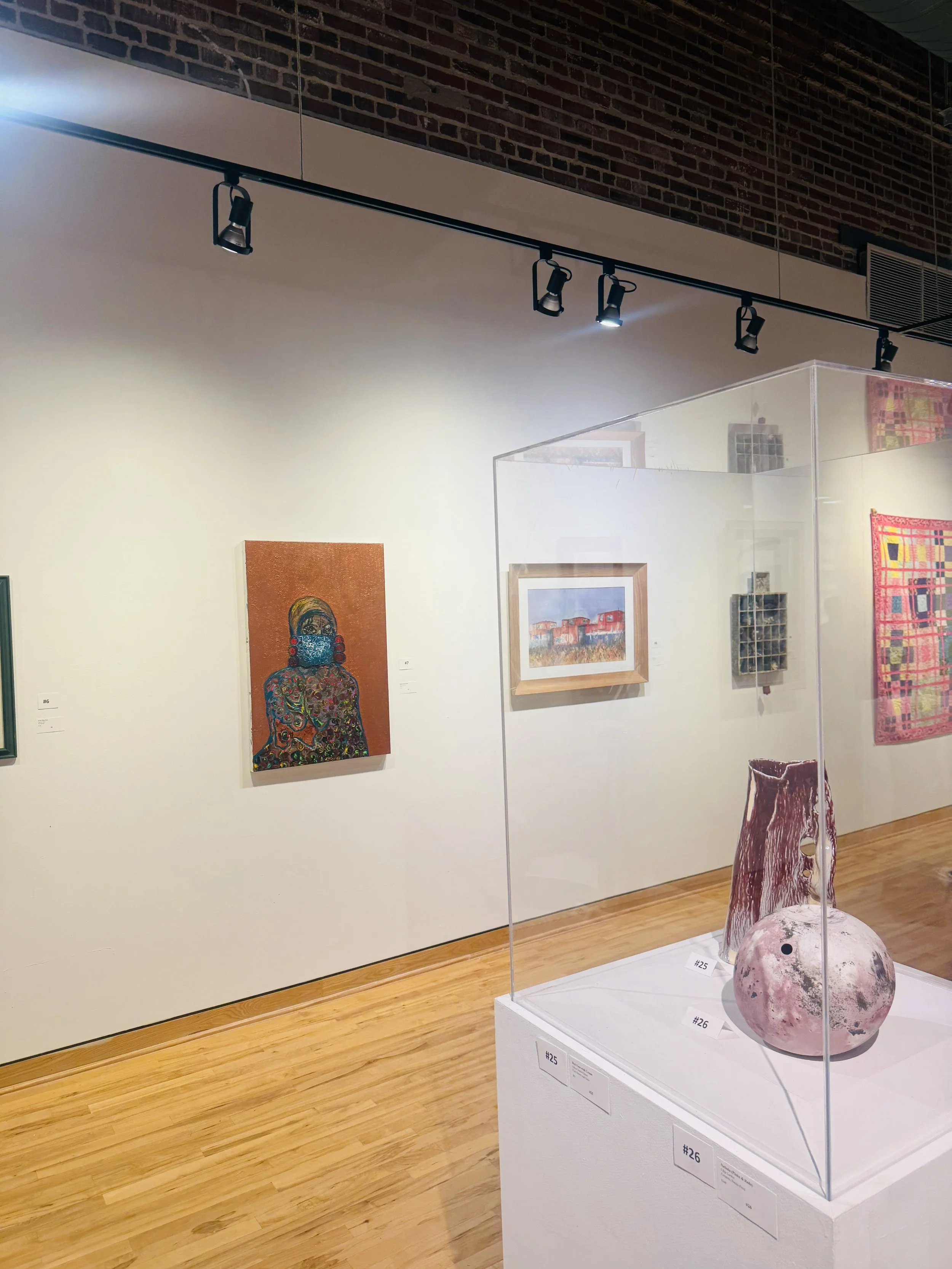
I painted the Amazigh tattoos that marked her body as part of a cultural language older than her own lifelines and signs that connected her to generations of women whose identities were written on skin rather than paper. I did not try to idealize her. I tried to hold her as she had been told to me: incomplete, distant, and real. Every brushstroke felt like negotiation between absence and presence. Between what I knew and what I could never know. Between history and imagination. At times, painting her felt like trespassing into a life I had no right to access. At other times, it felt like the only way to prevent her from dissolving completely. There is a moment I remember clearly from the process. I was working on her face, not trying to define it too sharply, when I realized I was no longer thinking about technique. I was thinking about her as a person who had once been twelve years old, sitting in the dust, holding wooden dolls, unaware that her life was about to change forever. That thought changed how I painted her eyes. I stopped trying to make them represent a fixed expression. Instead, I allowed them to hold contradiction. Fear and endurance. Confusion and resilience. Childhood and maturity. The painting became less about likeness and more about presence. Not who she was in an objective sense, but who she continues to be inside the memory of those who speak her name. When I finally stepped back from the finished work, I did not feel completion. I felt recognition. Not of her face, but of her absence finally given form. I did not expect the painting to leave the studio. For a long time, it belonged only to me. It was private work, something between memory and confession. But art rarely stays where it is first created. At some point, it enters other rooms, other eyes, other lives. When Hada Bent Brahim was exhibited, I stood quietly to the side, watching people approach her. Most viewers did not know her story.
They saw a woman whose gaze held something they could not immediately name. Some paused briefly before moving on. Others lingered longer, as if trying to locate a familiarity they could not quite place. A few asked questions, and I found myself repeating the same origin: a grandmother I never met, a story carried through my father, a life reconstructed through fragments. Then I saw her. An older woman standing still in front of the painting. She did not move for a long time and her hands were clasped in front of her body. Her eyes did not shift from the canvas. I remember thinking she might be reading something invisible there, something the rest of us could not access.
When I finally approached her, I asked quietly if she would like to hear the story behind the work. She nodded. So, I told her about Hada. As I spoke, I noticed her eyes filling slowly, not with dramatic tears, but with something heavier like the story of my grandmother resonated with her own story. When I finished, she remained silent for a long time. Then she said, "Your grandmother is from my generation. I was born in the forties too." Her voice was calm but not surprised. Not distant and simply certain. She began to speak about her own life and about growing up in a world where a husband’s permission was required for things that now feel ordinary. About women who could not open bank accounts on their own. About decisions that were never framed as choices at all. She did not speak with bitterness. She spoke as someone describing a landscape she had once lived inside.
As she spoke, I stopped seeing her as separate from my grandmother. For a moment, I saw an entire generation moving through her voice. She said we might be from different countries, but we had the same struggles, perhaps not at the same degree. Women who had lived through structures that shaped their possibilities before they ever had language to question them. When she finished speaking, she looked back at the painting. Neither of us said anything for a while as there was nothing left to explain. Only recognition. After that exhibition, I began to think differently about what I had painted. I had believed I was recovering one woman, but what I had encountered was something larger. A shared history that had never been fully recorded, but had been lived in bodies, in homes, in decisions made quietly within the limits of what was allowed.
Hada had never spoken of rights. She had never named what she was denied and yet her life was shaped by systems that defined what she could and could not do. Sometimes I think about how easily we speak today about progress, as if it arrived on its own. As if nothing had to be endured for it to exist. But when I think of my grandmother, I think of what came before language. Before rights were named. Before they were written into law or spoken in classrooms or debated in public spaces. I think of a girl holding wooden dolls in the dust, unaware that her childhood was about to end. I think of a woman holding a book upside down, believing deeply in an education she did not possess. I think of a grave near Marrakech where even a name began to disappear into plants. And I think of the painting, not as an object but as a form of return. A way of saying she was here and refusing disappearance.
There are rights that are spoken about as if they were simply discovered, as if they always existed waiting to be recognized. But sitting in front of that woman at the exhibition, listening to her describe her life, I understood something differently. Some freedoms are not inherited; they are slowly built through lives that do not always get remembered. Through women who did not live to see the language that would one day describe their experience. Through endurance that was never recorded as achievement. When I left the exhibition that day, I thought about Hada one more time and about how she might have understood none of this or perhaps understood it more clearly than I ever could. I thought about her grave and the name that had nearly been erased. About how easily silence can settle over a life and what remains when silence is interrupted. Her name is still Hada Bent Brahim and if I continue to speak it, it does not disappear because Hada lives inside of me.
Kawtar Lourhraz is a Moroccan-American figurative painter whose work explores feminine resilience, identity, and emotional transformation. With a background in engineering and social impact initiatives, Lourhraz brings a structural and human-centered sensibility to her artistic practice. Alongside her technical education, Lourhraz has been involved in social and community-focused initiatives, experiences that shaped her awareness of vulnerability, displacement, and resilience particularly in women’s lives. These themes surface in her work through upward gazes, exposed forms, and bodies emerging from dynamic fields of color. Rooted in Moroccan heritage and shaped by American life, Lourhraz’s work reflects layered identity. Her paintings blur abstraction and figuration, positioning women not as passive subjects, but as forces of becoming grounded, sovereign, and evolving.